A.W.
Tillinghast
The architect who made American golf bigger, bolder and more demanding — without making every course feel the same.
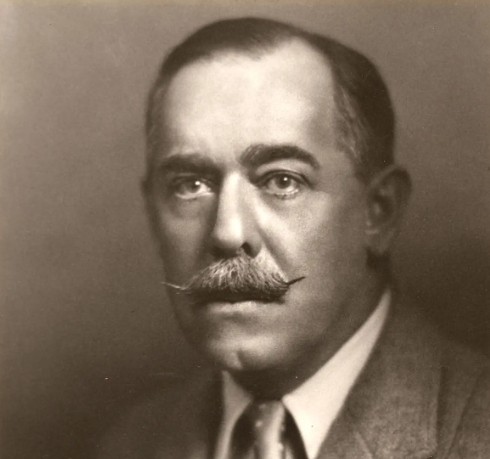
An American original whose best courses still feel built for consequential golf.
Albert Warren Tillinghast was born in Philadelphia in 1876 and became one of the defining American architects of golf’s Golden Age. Inspired in part by time spent with Old Tom Morris at St Andrews, he eventually put his fingerprints on hundreds of American courses, with an extraordinary concentration around New York, New Jersey and the Northeast.
The famous names tell only part of the story: Winged Foot, Baltusrol, Bethpage, Quaker Ridge, Somerset Hills and San Francisco Golf Club. Tillinghast could build stern championship golf, but he was not a one-note architect. His strongest work changes with the land. What carries through is consequence — formidable green complexes, bunkers that matter, bold scale and a constant sense that the next shot has to be earned rather than merely executed.
Born in Philadelphia
Albert Warren Tillinghast is born into a prosperous Philadelphia family and grows up in the city that would help shape his early golf life.
St Andrews leaves a mark
Time in Scotland and encounters with Old Tom Morris deepen Tillinghast’s fascination with golf and the possibilities of course design.
From player to architect
Tillinghast moves into course design and begins building and reshaping clubs across the Northeast and beyond.
Baltusrol changes the scale
His ambitious Upper and Lower Courses establish a 36-hole statement and help launch the mature Tillinghast design language.
The defining run
Winged Foot, Quaker Ridge and a dense collection of metropolitan New York work arrive during the peak of his practice.
Public golf and a lasting canon
Bethpage and later work broaden the legacy before his death in 1942; the strongest courses remain central to American championship golf.
A national portfolio with its gravitational center around New York and the Northeast.
Tillinghast worked across the United States, but his TCR footprint makes the concentration unmistakable: New York, New Jersey and the surrounding Northeast hold an unusually dense collection of his most important work.
16 states represented in the current TCR catalog
What makes a great Tillinghast course feel unmistakably consequential.
TCR’s strongest Tillinghast courses point toward architecture built around scale, demanding green complexes and hazards that influence the shot before the golfer ever reaches them.
Greens with authority
Tillinghast greens can dominate the hole: strongly contoured, elevated or shaped so that simply hitting the surface does not finish the problem. The putting complex often determines where the approach needs to come from.
Bunkers as architecture
The best hazards are not decoration. Deep faces, bold forms and positions tied directly to useful angles make the bunkers part of the strategy — and give many Tillinghast courses their visual muscle.
Championship scale
There is often a sense of breadth and consequence to the strongest work. Long holes feel substantial, major features read clearly, and the course can ask hard questions without relying on artificial narrowness.
Strategy before punishment
The reputation can be severe, but the architecture is more interesting than simple difficulty. Position changes the next shot, preferred angles matter and hazards force decisions rather than merely collecting misses.
A chameleon, not a formula
Winged Foot does not feel like Somerset Hills, and Baltusrol does not feel like San Francisco Golf Club. Tillinghast adapted his expression to the property while keeping the underlying golf demanding and legible.
The traits the highest-rated Tillinghast-attributed courses consistently lean into — ranked without pretending the decimal points are the story.
Architecture reflects TCR Architectural Interest. Green Complexity isolates the putting surfaces and surrounds — intentionally separate signals.
How much of the portfolio sits behind the gate?
*Publicly accessible includes Public, Resort, Municipal and Semi-Private classifications in the current TCR catalog.
The footprint is the visual.
Three architects that live nearby in TCR’s DNA.
This is not a historical lineage claim. It compares each architect’s highest-rated TCR courses across Architecture, Green Complexity, Conditioning, Shot Variety, Difficulty, Scenery and Walkability. Frequent co-attributions are excluded so restoration overlap does not manufacture a match.
Jim Wagner
Closest overlap: Conditioning · Architecture · Walkability
Tom Doak
Closest overlap: Green Complexity · Architecture · Walkability
Kyle Franz
Closest overlap: Shot Variety · Green Complexity · Architecture
Three courses. One body of work that never needed a single visual signature.
The ten highest-rated Tillinghast-attributed courses in TCR.
Pine Valley Golf Club
Sleepy Hollow Country Club
Winged Foot Golf Club (West Course)
Baltusrol Golf Club - Lower Course
Philadelphia Cricket Club (Wissahickon Course)
Baltusrol Golf Club - Upper Course
Newport Country Club
Essex County Country Club
Winged Foot Golf Club (East Course)
Fenway Golf Club
The courses worth knowing after the famous names.
TCR discovery signals surface Tillinghast-attributed courses whose quality deserves more attention than conventional recognition suggests.
Brook Hollow Golf Club
Golden Age shot-maker’s test in the heart of Dallas
Country Club of Fairfield
Classic Raynor strategy meets wind off the Sound
Wykagyl Country Club
Layered Golden Age architecture, legendary greens, classic challenge
Golden Valley Country Club
A Tillinghast classic, reborn for modern play
Oklahoma City Golf & Country Club
Oklahoma's classic test of strategy and precision
Omni Bedford Springs Resort - Old Course
A Golden-Age Classic Revived in Resort Splendor
See your history inside the Tillinghast portfolio.
Sign in to see how much Tillinghast you’ve played, the courses already on your Want to Play list, and the strongest Tillinghast-attributed courses still waiting for you.
Sign in to see your TillinghastEvery A.W. Tillinghast design credit in The Caddie Report.
The live catalog — separated into original designs and work on existing courses, while preserving the distinction between renovations, restorations and redesigns underneath.