Pete
Dye
The architect who made golfers uncomfortable on purpose — using visual deception, tiny targets and wicked angles to force decisions they could not ignore.
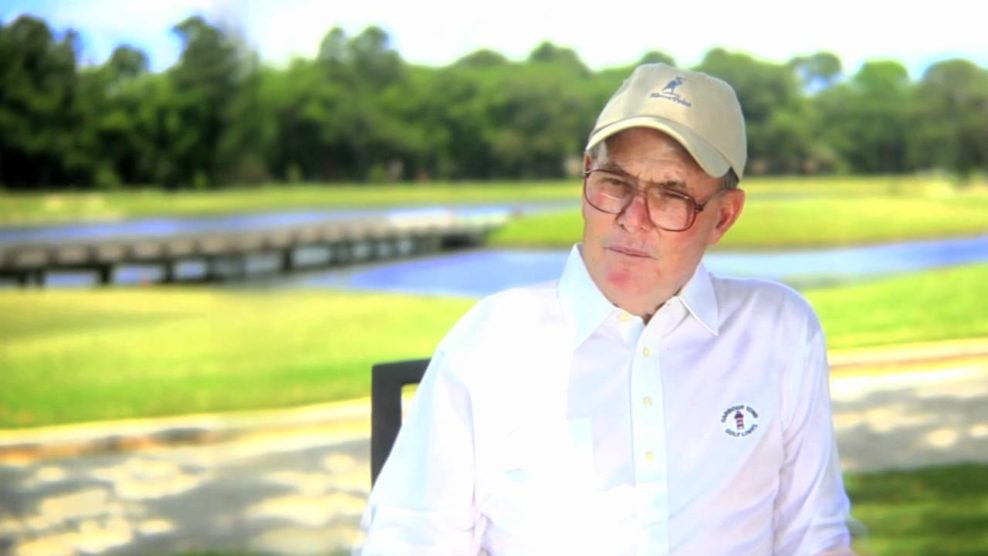
Pete Dye did not want golf to feel comfortable. He wanted it to stay in your head.
Pete Dye changed modern American golf by refusing to make it polite. Influenced by Britain and Ireland and working closely with Alice Dye, he built courses that could look intimidating, eccentric or even unfair before revealing the strategy underneath. Harbour Town, TPC Sawgrass, Crooked Stick, Whistling Straits and the Ocean Course at Kiawah made his visual vocabulary famous, but the deeper influence is how Dye manipulated perception and choice.
The trap is focusing only on the theater — island greens, railroad ties, pot bunkers and bulkheads. The better question is what the theater makes you do. Fairways can look narrower than they play. A terrifying hazard may guard the line that creates the easiest next shot. Tiny greens magnify the value of position. Dye constantly plays with what the golfer sees versus how much room actually exists. The course is trying to get inside your decision-making before you swing.
A national footprint with distinct centers of gravity.
The geography of the portfolio helps tell the story of the practice.
24 states represented in the current TCR catalog
How to survive Pete Dye once the course starts messing with your head.
Do not confuse what looks terrifying with what is actually impossible. Dye's greatest trick is making perception itself part of the strategy.
Intimidation is information
A frightening view often exaggerates danger and tests whether the golfer can identify the real amount of room.
Angles beat straight lines
The safest route and the best route are frequently different.
Small targets amplify position
Compact greens make the location of the previous shot disproportionately important.
Artificial can still be strategic
Railroad ties, bulkheads and constructed forms are tools for shaping decisions, not just visual signatures.
The joke is sometimes on you
Dye enjoyed making golfers question what they saw. Understanding the illusion is part of solving the hole.
The traits the highest-rated Dye-attributed courses consistently lean into — ranked without pretending the decimal points are the story.
Architecture reflects TCR Architectural Interest. Green Complexity isolates the putting surfaces and surrounds — intentionally separate signals.
How much of the portfolio sits behind the gate?
*Publicly accessible includes Public, Resort, Municipal and Semi-Private classifications in the current TCR catalog.
The footprint is the visual.
Three architects that live nearby in TCR’s DNA.
This is not a historical lineage claim. It compares each architect’s highest-rated TCR courses across Architecture, Green Complexity, Conditioning, Shot Variety, Difficulty, Scenery and Walkability. Frequent co-attributions are excluded so restoration overlap does not manufacture a match.
Rees Jones
Closest overlap: Scenery · Conditioning · Shot Variety
Robert Trent Jones Sr.
Closest overlap: Shot Variety · Green Complexity · Architecture
Jim Wagner
Closest overlap: Conditioning · Shot Variety · Difficulty
Three courses. One body of work that never needed a single visual signature.
The ten highest-rated Dye-attributed courses in TCR.
The Ocean Course at Kiawah Island
Whistling Straits (Straits Course)
Piping Rock Club
Harbour Town Golf Links
TPC Sawgrass (Stadium Course)
The Honors Course
The Golf Club
French Lick Resort – Pete Dye Course
Pete Dye Golf Club
Oak Tree National Golf Club
The courses worth knowing after the famous names.
TCR discovery signals surface Dye-attributed courses whose quality deserves more attention than conventional recognition suggests.
The Dye Course at White Oak
Pete Dye’s secluded late-career strategic masterpiece
Old Marsh Golf Club
Wetland-framed Dye masterpiece demanding precision
Country Club of Birmingham – West Course
Historic Ross pedigree with championship-tested bite
Austin Country Club
Hill Country drama, strategic Dye puzzles, elite Texas tradition
Gulf Stream Golf Club
Classic Donald Ross by the Atlantic breeze
See your history inside the Dye portfolio.
Sign in to see how much Dye you’ve played, the courses already on your Want to Play list, and the strongest Dye-attributed courses still waiting for you.
Sign in to see your DyeEvery Pete Dye design credit in The Caddie Report.
The live catalog — separated into original designs and work on existing courses, while preserving the distinction between renovations, restorations and redesigns underneath.