Donald
Ross
The architect who taught American golf to think from the green backward.
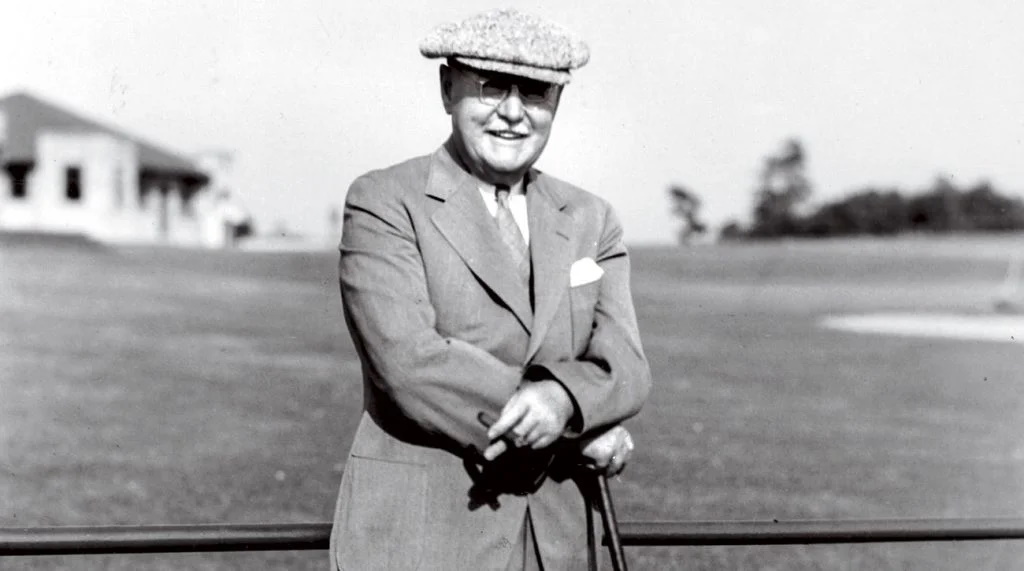
A body of work worth understanding.
Donald Ross did not build one kind of golf course. He helped build an American golf language. Raised in Dornoch and trained in the Scottish game before arriving in the United States in 1899, Ross spent much of his career moving between New England and Pinehurst while his practice spread across the country.
The best Ross courses rarely overwhelm you with spectacle. They reveal themselves through angles, natural movement and, above all, the ground around the greens. A Ross approach can look straightforward from 150 yards and become completely different depending on which quadrant of the putting surface you find. The architecture rewards position, imagination and restraint — which is why a century later his strongest courses still feel so playable and so difficult to solve.
Born in Dornoch
Ross grows up beside Royal Dornoch and learns the Scottish game on linksland.
Arrives in America
He begins his American career at Oakley Country Club outside Boston.
The Pinehurst chapter begins
Ross heads south and starts the relationship with Pinehurst that will define his American legacy.
A national practice
Commissions spread through the Northeast, Carolinas, Florida and industrial Midwest.
The mature Ross language
Many of the courses now considered his defining work take shape or receive major Ross redesigns.
A half-century of influence
Ross dies after reshaping the vocabulary of American golf architecture.
A national footprint with distinct centers of gravity.
The geography of the portfolio helps tell the story of the practice.
28 states represented in the current TCR catalog
What actually makes Ross's work distinctive.
TCR’s course data points to the pattern. The architecture explains why it matters.
Greens as the defense
Ross courses often save their hardest questions for the final 40 yards: crowned surfaces, subtle falloffs and recoveries that make the putting complex the real center of strategy.
Strategic width
The fairway can look generous, but the easy side is not always the useful side. Better angles are earned by choosing a line, not simply finding short grass.
Natural routing
The strongest Ross courses feel discovered rather than imposed. Slopes, ridges and landforms do the work, giving holes movement without unnecessary construction or spectacle.
Variety over repetition
Different lengths, shot shapes and approach questions keep the round changing. Ross rarely asks the same question twice when the property gives him another option.
Architecture that endures
The underlying ideas are strong enough to survive changing equipment and restoration cycles. A century later, the best Ross courses still reward position, restraint and imagination.
The traits the highest-rated Ross-attributed courses consistently lean into — ranked without pretending the decimal points are the story.
Architecture reflects TCR Architectural Interest. Green Complexity isolates the putting surfaces and surrounds — intentionally separate signals.
How much of the portfolio sits behind the gate?
*Publicly accessible includes Public, Resort, Municipal and Semi-Private classifications in the current TCR catalog.
The footprint is the visual.
Three architects that live nearby in TCR’s DNA.
This is not a historical lineage claim. It compares each architect’s highest-rated TCR courses across Architecture, Green Complexity, Conditioning, Shot Variety, Difficulty, Scenery and Walkability. Frequent co-attributions are excluded so restoration overlap does not manufacture a match.
Tom Doak
Closest overlap: Architecture · Shot Variety · Walkability
Ben Crenshaw
Closest overlap: Architecture · Shot Variety · Walkability
Perry Maxwell
Closest overlap: Shot Variety · Difficulty · Walkability
Three courses. One body of work that never needed a single visual signature.
The ten highest-rated Ross-attributed courses in TCR.
Pinehurst Resort (No. 2 Course)
Seminole Golf Club
Oakland Hills Country Club (South Course)
Oak Hill Country Club - East
Inverness Club
Essex County Club
Aronimink Golf Club
Interlachen Country Club
East Lake Golf Club
Whippoorwill Club
The courses worth knowing after the famous names.
TCR discovery signals surface Ross-attributed courses whose quality deserves more attention than conventional recognition suggests.
Skokie Country Club
Golden Age strategy where Chicago’s elite golf meet
Mid Pines Golf Club
Classic Donald Ross sandhills strategy restored to glory
Wannamoisett Country Club
Legendary Rhode Island Ross, newly revitalized.
Pinehurst Resort (No. 4 Course)
Strategic Sandhills drama—Pinehurst’s bold, modern classic
Cedar Rapids Country Club
Iowa’s only Donald Ross-designed classic
The Minikahda Club
Restored Ross gem high above Bde Maka Ska
Chevy Chase Club
Classic strategic pedigree meets fresh restoration
Holston Hills Country Club
A living Donald Ross classic reborn in Tennessee
See your history inside the Ross portfolio.
Sign in to see how much Ross you’ve played, the courses already on your Want to Play list, and the strongest Ross-attributed courses still waiting for you.
Sign in to see your RossEvery Donald Ross design credit in The Caddie Report.
The live catalog — separated into original designs and work on existing courses, while preserving the distinction between renovations, restorations and redesigns underneath.